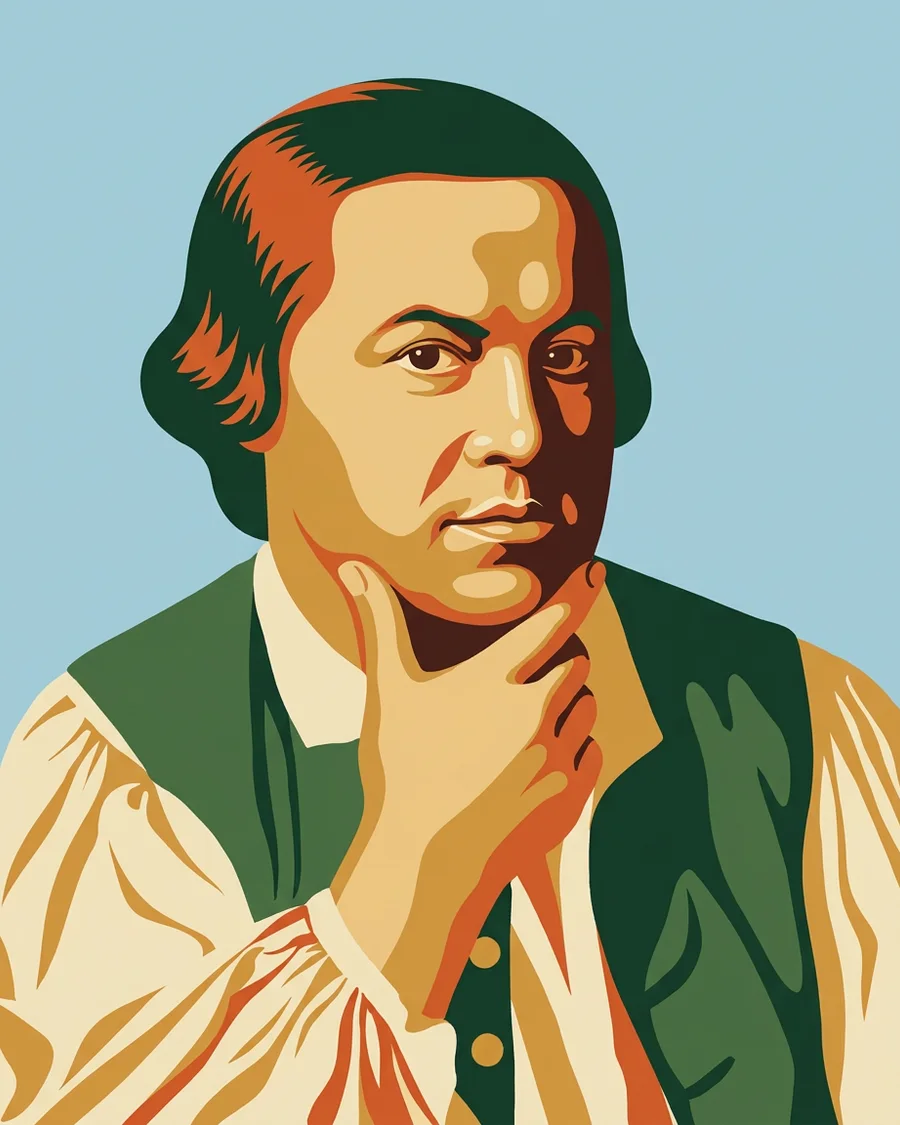
Our drawing of the original: John Singleton Copley, 1768. Public domain. See the original
1734–1818
Paul Revere
Silversmith and midnight rider · Boston's North End
A Boston silversmith with sixteen children and a dozen side jobs, from engraving to cleaning teeth. On April 18, 1775, he rode through the night to warn that British soldiers were coming.
“You'll have noise enough before long. The regulars are coming out!”
To a guard at Lexington, after midnight on April 19, 1775, as the story was later told
Paul Revere knows everything up to 1818, and nothing after. Ask about something from your time, and see what they make of it.
Questions to ask Paul Revere
Paul Revere facts for kids
- 1Paul Revere was born in Boston's North End in December 1734. His father came from France as a boy named Apollos Rivoire and changed his name to Paul Revere. His father was a goldsmith.
- 2Revere learned to work gold and silver in his father's shop. His father died when Revere was 19, and Revere took over the shop to support the family. For more than 40 years, his shop made everything from spoons to fine tea sets.
- 3Revere married Sarah Orne in 1757, and they had eight children. Sarah died in 1773. After that, he married Rachel Walker, and they had eight more children. He had sixteen children in all.
- 4When money was short, Revere took other work too. He engraved pictures and political cartoons on copper. From 1768 to 1775, he cleaned teeth and fitted false teeth. He did not make George Washington's false teeth.
- 5After the Boston Massacre in 1770, Revere made and sold a famous engraving of it, called "The Bloody Massacre." It showed the soldiers firing on purpose, which wasn't exactly how it happened.
- 6Revere helped plan the Boston Tea Party in December 1773. The next day, he rode to carry the news to New York and Philadelphia.
- 7In 1774 and 1775, Revere was an express rider. He carried news and messages as far as New York and Philadelphia.
- 8On the night of April 18, 1775, Dr. Joseph Warren sent Revere to warn Samuel Adams and John Hancock in Lexington. British soldiers were marching out. Revere had two lanterns hung in the steeple of Christ Church, the Old North Church. They signaled that the soldiers were crossing the river by boat. The signal was one lantern if by land, two if by sea.
- 9Two friends rowed Revere across the river to Charlestown. They slipped past the British warship Somerset in the dark. In Charlestown, he borrowed a horse from John Larkin. Revere never said the horse's name. He just called it a very good horse.
- 10Revere rode through Medford and Menotomy and warned almost every house. He reached Lexington after midnight. A guard asked him not to make so much noise. Revere said, "Noise! You'll have noise enough before long. The regulars are coming out!" He did not shout "The British are coming." The people he was warning thought of themselves as British too.
- 11William Dawes took another road and reached Lexington too. On the way to Concord, a British patrol caught Revere. Dawes and Dr. Samuel Prescott got away, and Prescott warned Concord. The soldiers questioned Revere, took his horse, and let him go. He walked back to Lexington and saw the end of the fight on the green.
- 12In the war, Revere printed money for Massachusetts and served as an artillery officer. In 1779, he was part of an expedition at Penobscot Bay in Maine that failed badly. He asked for a court-martial to clear his name. In 1782, the court found him not guilty.
- 13After the war, Revere opened a foundry that made bolts, cannons, and church bells. It also supplied fittings for the warship USS Constitution. In 1801, he opened the first successful copper rolling mill in North America.
- 14Revere named one of his sons Joseph Warren Revere. He named him after his friend Dr. Warren, who was killed at Bunker Hill.
- 15Revere retired at 76. He died in Boston on May 10, 1818, at 83.
What did Paul Revere look like?
The picture on this page is our drawing of a portrait by John Singleton Copley, from 1768. See the original.
How we know
Paul Revere speaks only from 15 facts we checked against these sources. The voice is AI, so it can still slip. If something sounds off, look it up together.